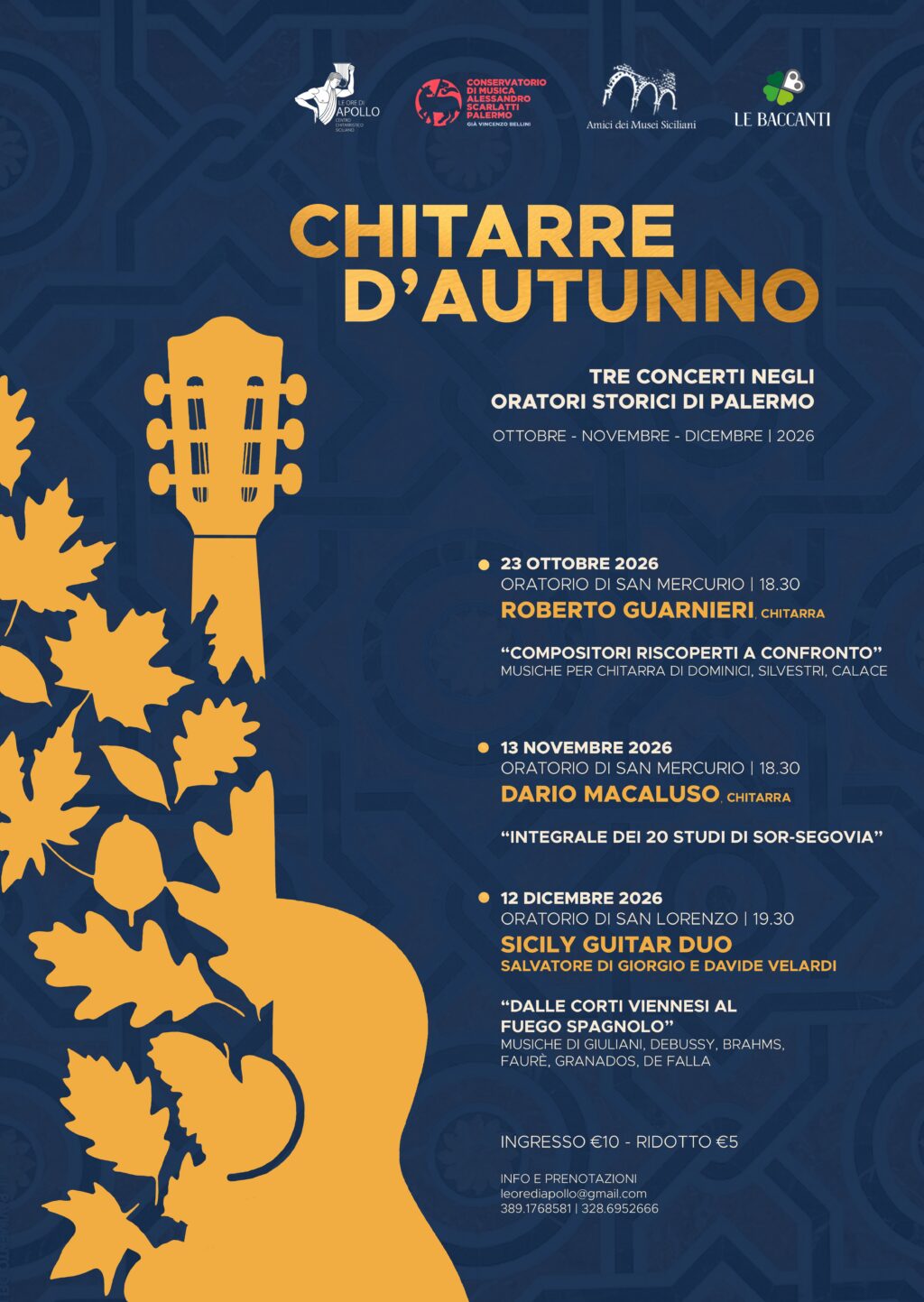
A journey through the history of classical guitar, from lesser-known works by Italian composers of the nineteenth and early twentieth centuries to masterpieces of the European repertoire, through musical research, historical exploration, and interpretative insight. This is the guiding thread of the autumn concert series organised by the Le Ore di Apollo Association, which presents three events in Palermo between October and December, set in the evocative surroundings of the Oratory of San Mercurio and the Oratory of San Lorenzo.
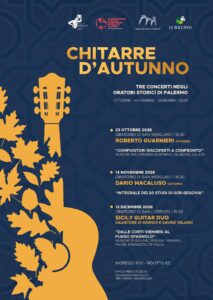
The series opens on Thursday, 23 October, at 6.30 pm at the Oratory of San Mercurio, with guitarist Roberto Guarnieri, a soloist from Imola, performing a programme dedicated to the rediscovery of composers and works rarely featured in concert programmes. The series continues on 13 November, also at 6.30 pm at San Mercurio, with Dario Macaluso, a professor at the Palermo Conservatory and president of the Le Ore di Apollo Association, who will perform all twenty of Fernando Sor’s studies in the celebrated Sor–Segovia selection. The series concludes on 12 December at 7.30 pm at the Oratory of San Lorenzo, with the guitar duo of Davide Velardi and Salvatore Di Giorgio, presenting a musical journey through the nineteenth-century guitar repertoire and some of the best-known works of the European instrumental tradition.
The series aims to showcase classical guitar in its many forms, bringing musicological rediscovery into dialogue with performance traditions and the richness of the chamber music repertoire. Each concert offers an opportunity to explore different periods, styles, and musical personalities, with programmes designed not only to provide an engaging listening experience but also to encourage knowledge and deeper understanding.
23 October: Roberto Guarnieri and the Rediscovery of Overlooked Composers
The opening concert, scheduled for Thursday, 23 October, at 6.30 pm at the Oratory of San Mercurio, features Roberto Guarnieri, a soloist from Imola, in a retrospective devoted to rarely performed music by Antonio Dominici, Primo Silvestri, and Raffaele Calace.
These composers were versatile instrumental musicians, closely associated with the mandolin and guitar traditions, who contributed to Italian musical life from the late nineteenth century through the first half of the twentieth century. Their works reveal a rich expressive landscape in which lyricism, salon music, dance forms, and Romantic sensibilities coexist.
The concert will be preceded by a historical and artistic introduction exploring the context in which these composers lived and worked, reconstructing the cultural background of a valuable repertoire that is now seldom heard in concert halls.
The programme includes Antonio Dominici (1872–1934): Fantasia patetica, Gloria palermitana, Elegia, and La pastorella. Works by Primo Silvestri (1871–1960) will include Dolce risveglio nel bosco, Serenata alla Luna, and Improvviso. The concert will conclude with several compositions by Raffaele Calace (1863–1934): Duettino dell’amore, Barcarola, Danza di bambole, and Mon capitan qui passe.
This programme invites audiences to rediscover musical works that reveal the diversity of an instrumental tradition often overlooked in the more familiar concert repertoire.
13 November: Dario Macaluso and the Complete Sor–Segovia Studies
The second concert will take place on Thursday, 13 November, at 6.30 pm, again at the Oratory of San Mercurio, featuring Dario Macaluso, a professor at the Palermo Conservatory and president of the Le Ore di Apollo Association.
At the heart of the evening will be the complete set of twenty studies by Fernando Sor (1778–1839), in the selection curated by Andrés Segovia, a collection that has become an essential reference in the training of classical guitarists.
Segovia’s selection helped establish these studies as a mainstay of guitar teaching and concert performance, highlighting works that combine technical discipline, formal balance, and musical depth. Sor, a central figure in the history of the guitar between the eighteenth and nineteenth centuries, continues to represent a meeting point between instrumental exploration and the pursuit of interpretative understanding.
On this occasion, too, the performance will be preceded by a historical and philological introduction to Fernando Sor and the origins of his studies, offering the audience a deeper understanding of the repertoire and its significance within the guitar tradition.
12 December: Velardi and Di Giorgio — Classical Guitar in a Chamber Duo
The series concludes on Saturday, 12 December, at 7.30 pm, in the setting of the Oratory of San Lorenzo, with the guitar duo of Davide Velardi and Salvatore Di Giorgio, two performers united by a strong artistic background.
The programme traces a path from the nineteenth-century guitar repertoire through celebrated works of European music, reimagined through the tonal colours and conversational possibilities of the two-guitar format. Alongside the Italian tradition of Mauro Giuliani, the programme explores the atmospheres of Gabriel Fauré and Claude Debussy, the expressive depth of Johannes Brahms, and the distinctive colours of the Spanish national school through Enrique Granados and Manuel de Falla.
The evening opens with Mauro Giuliani’s (1781–1829) Tre Polonesi Concertanti, Op. 137, followed by Fauré’s (1845–1924) Pavane, Op. 50, in a transcription for guitar duo, and Debussy’s (1862–1918) Clair de Lune from the Suite bergamasque, also transcribed for this ensemble.
The programme continues with Brahms’s (1833–1897) Theme and Variations, Op. 18b, drawn from his String Sextet No. 1, Op. 18, in an arrangement for two guitars, and Giuliani’s Sinfonia from the opera The Barber of Seville.
The final section is devoted to the Spanish tradition, featuring Granados’s (1867–1916) Danza Española No. 2, “Oriental”, from 12 Danzas Españolas, Op. 3, and Manuel de Falla’s (1876–1946) Danza del Molinero, from the ballet The Three-Cornered Hat (El sombrero de tres picos).
This musical journey highlights the expressive possibilities of the guitar in chamber music, through transcriptions and reinterpretations that bring out the melodic and harmonic richness of works originally written for different instrumental ensembles.
Music Meets Palermo’s Cultural Heritage
The three concerts will take place in two venues of outstanding historical and artistic significance in Palermo’s city centre: the Oratories of San Mercurio and San Lorenzo. These spaces provide a setting in which music enters into dialogue with the city’s monumental heritage and cultural traditions.
The series is organised by the Le Ore di Apollo Association in collaboration with the Amici dei Musei Siciliani Association, chaired by Prince Bernardo Tortorici. Its aim is to promote awareness of the guitar repertoire through high-quality performances, musicological insights, and opportunities for dialogue between performers and audiences.
Three concerts, three different perspectives, and one instrument at the heart of the journey: the classical guitar, celebrated in a season that treats musical memory not as a static legacy, but as a living heritage to be rediscovered and shared.
CONCERT SCHEDULE
Thursday, 23 October – 6.30 pm
Oratory of San Mercurio
Roberto Guarnieri
Music by Antonio Dominici, Primo Silvestri, and Raffaele Calace.
Thursday, 13 November – 6.30 pm
Oratory of San Mercurio
Dario Macaluso
Fernando Sor: 20 Studies — complete Sor–Segovia selection.
Saturday, 12 December – 7.30 pm
Oratory of San Lorenzo
Davide Velardi – Salvatore Di Giorgio
Music by Mauro Giuliani, Gabriel Fauré, Claude Debussy, Johannes Brahms, Enrique Granados, and Manuel de Falla.
Organised by: Le Ore di Apollo Association.
In collaboration with: Amici dei Musei Siciliani, chaired by Prince Bernardo Tortorici.
With the support of: Cooperativa Le Baccanti.
About The Author